Skills That Make a Great Fashion Designer

You cannot talk about fashion designers without referring to fashion icons like Sabyasachi Mukherjee, Virgil Abloh, Manish Malhotra and Coco Chanel.

They were not only responsible for the creation of garments, but also for the design. They built identities.

Coco Chanel revolutionised the industry by giving women fashion that was comfortable and simple. Sabyasachi became a world-class brand based on Indian values. Manish Malhotra transformed Bollywood style, and Virgil Abloh revolutionised streetwear into luxury fashion.

Different journeys. Different styles.

Strong skills were common, though.

So many students today enrol in a fashion design course or have an interest in a Fashion Designing Course, and they believe that it is just a matter of creating fashion sketches. Others wish to acquire some skills in fashion design by watching videos or attending lessons for a couple of weeks. However, in a flash, it is evident that one thing stands out.

It’s not just about ideas in fashion design.

It’s about execution.

If you have a passion for fashion and desire to pursue a real career in fashion design, it’s not enough to be creative. Correct fashion design background, training, and ability are essential. Hence, it is crucial for one to select the appropriate fashion design institute near me or a fashion design institute.

After all, it’s a skill that makes one a designer.

Skills You Need to Become a Fashion Designer
Even if you join a fashion design beginner course, you should still have a look at these basic skills:

1. Creativity with Direction

Remember, it’s creativity but not anything slapdash.

Spend some time in your designer’s mind considering collections rather than individual designs. An understanding of themes/inspirations and how designs are linked. It takes time to build up during a correct fashion design course for novices or perhaps even an experienced course in fashion design.

No, they’re not good ideas,  good ideas that can work in the market.

2. Fabric & Material Understanding

Fashion is the fundamental of fabric.

The same design would appear altogether different on cotton, silk, or denim. To get a grasp on the concept:

How it hangs from the fabric (fall)

Texture and feel

Durability

One should have knowledge of different clothes. Also the ability to wear clothes suitably.

It’s a time of understanding gained through fashion design lessons and practical experience, rather than theory.

3. Technical Skills (Construction & Pattern Making)

Fashion design: it’s not only creative but technical.

You need to know:

  • Pattern making
  • Garment construction
  • Stitching basics
  • Fit and measurements


Otherwise, your design will not be done correctly. A lot of fashion design schools put such emphasis on this, as this is what makes drawings come to life as clothes.

Try to have the ability to recognise fashion trends and understand the market’s current tastes and demands.

4. Trend Awareness & Fashion Sense

It’s crucial to be aware of fashion trends, popular colours, and cuts, as well as international fashion trends. However, more than that, you need to understand what is appropriate for your audience.

Industry knowledge helps in attaining a balance between the trend and originality. That’s why students in the best fashion design courses are trained in observing, analysing, and adapting.

5. Communication & Presentation Skills

The design is only half the job done.

You should be able to convey your ideas effectively, as well. Your presentation of your design is highly significant regardless if it’s for clients, the team, or their clients.

This includes:

Portfolio presentation

Mood boards

Client communication


These skills are taught in Fashion design as part of the profession and play an important role in establishing and shaping your personality as a fashion designer.

6. Problem-Solving & Adaptability

Fashion is unpredictable. Fabric may not be present. The design may not achieve the desired results. Last-minute changes might be requested by clients. Quick adaptations must be made.

Every time a good designer is not at a loss, he/she has a solution ready. The attitude comes to life through real projects and a good education of fashion design.

Why Does Learning the Right Way Matter?

When you are really interested in how to become a fashion designer, skills have more weight than anything else.

Skills don’t just happen from watching videos!

They come from:

  • Structured learning
  • Practical exposure
  • Real project work

That’s why enrolling in the right fashion design institute or pursuing fashion design colleges can make a distinction. From knowing what the fashion design course entails to understanding the cost of the fashion design course, the perfect choice becomes yours, which determines what you are headed towards.

Well, it’s not only about learning theory at institutes like NIF Global. They take real hands-on experience in fashion through practical, guided projects and industry exposure.

Fashion, however, is not simply about learning.

It’s about creating. Even fashion design diploma courses teach a lot.

Wrap Up

On the surface, it appears fashion design might be showy.

But you have to work hard, have talent, and learn all the time behind every collection.

Establish a robust career in fashion design, and take steps to acquire the right skills gradually. Select the suitable fashion design certificate, course, or training to provide actual exposure.

It can’t be about the quantity of designs you make, after all.

It’s the execution of them that matters!

Top Skills Every Interior Designer Must Have

So what really makes a good interior designer?

Many people begin by enrolling in an interior design course or even attempt to learn interior design from the comfort of their home with an online interior design course or an online interior design class. With so many options like interior design certification online, interior design diploma online, or even an interior design course online free, it feels like everything you need is easily available.

However, as you go out, you realize that it is not so because…

Interior design is more than aesthetics. It’s the way that it works. The movement of people, the fitting of elements, and how things come to life in a real situation. There, it’s not only about creativity anymore; skills come into play.

That is what the difference is between dreaming about learning… and really becoming a designer.

Understanding Space

Space is the beginning of all forms of interior design. It’s not only about furniture placement, or decorating the walls! It’s being aware of the use and usability of a space and how it flows.

While working in real spaces is the best way to gain a real understanding, you can also learn the basics via online interior design classes or an interior design beginner course.

Strong Design Sense

Creativity is essential but it must have direction. A good sense of design implies being aware of balance, color combinations, textures, and harmony.

This is created with interior design learning and regular exposure. This is why the top interior design programs emphasize creativity, as well as design thinking.

Knowledge of Materials

Many materials may be different in real life from what you will view in an online study of interior design or even in an online interior design degree. One of the most important tasks is knowing the best places to go, how long it will last, and how much it will cost.

Communication Skills

Interior design is not something you do alone.

You work with clients, vendors, and teams. You need to clearly explain your ideas and understand expectations. This is something no interior design certification can fully teach, but the way they teach plays a huge role in real projects.

Technical Knowledge

Design is more than visual. Some technical knowledge is required as well.

Layouts and measurements, software tools, all part of it! While many interior design courses and interior design professional courses teach skills such as AutoCAD or SketchUp, using these in real-world projects is a different story.

Problem-Solving Ability

Life isn’t always as successful as it could be.

There is a design that may not fit. Materials may not be available. The decision to change may be made by the client. It’s what you do with it that counts.

It is one of the most essential interior design skills, and it is developed using actual experience.

Attention to Detail

It is the little details that make all things happen.

The overall space can be affected by a slight difference in color, a wrong measurement, or a mismatch in lighting. Any good designer will be aware of these details on the ground and correct them before they become issues.

Practical Exposure

It is this that ties everything together.

There are different approaches, such as interior design education programs, interior design programs, and even attempting to learn interior design via different apps. But until you work on real projects, things don’t fully make sense.

Real exposure creates confidence, clarity and real understanding.

Why Does Learning the Right Way Matter?

When it comes to pursuing a career in interior design, skills are more important than anything else.

Skills are not learned while observing but are acquired through practice.

This is why it is important to select the right interior design institute. You may ask yourself, how can you become an interior designer? Proper guidance, systematic learning, and exposure.

The emphasis at NIF Global isn’t in the theory but on the students getting hands-on experience with design through assignments, projects, and exposure.

Interior design is no walk in the park.

It’s something you have to learn.

Conclusion

Interior design is more than creativity; it’s an art learned through skill.

To pursue an Interior design career, learn the right skills rather than gathering bits and bits of information from other sources.

After all, it is not what you know that matters most.

It’s based on what you are able to create.

Can You Really Learn Interior Design Online?

A question that comes in everyone’s mind – Is it possible to learn interior design online?

It sounds easy. You enrol in an online interior design class, watch a few videos and begin to design interiors. There are countless interior design courses online these days, and it seems as though you’ve got all that you require just within your reach.
Actually, that’s how most people start…

Here’s one important thing most will discover later in their career, however: interior design isn’t just a matter of mastering. It’s about physical reality, not just talking about it.

If you are at the beginning of the process, you are thinking of starting with basics. You should consider taking an interior design course for beginners or even the free online interior design course. As we know, many design program options are available, and some are even listed among the best interior design courses for beginners.

So, is an online interior design course enough?

Interior design online classes are a good starting point.

You can acquire fundamental design concepts, learn color theory and layouts, and even get lessons in AutoCAD or SketchUp! Numerous interior design online courses provide you with an understanding of design, as well as space planning.

Initially, it’s just an easy job to do. You learn quickly. You get ideas. You feel confident.

However, after a while, the following becomes difficult for you:

To know design and to apply design, there is a big difference.

Where does online learning fall short?

Interior designing isn’t restricted to the screen!

In real projects:

  • The measurements are not exact.
  • As the materials are not the same when in use, it does not look exactly the same.
  • Lighting changes everything
  • Little details make a big difference

Such are real issues.

This is something that an online interior design course will not be able to prepare you for. One cannot get the advanced interior design skills.

Why does practical learning matter more?

Interior design is a hands-on course.

You don’t just create; you do things.
You need to:

Visit real sites

Understand materials physically

Build or design a real space. 

Construct or design a space.

Real client expectations are to be handled.

This is the place for REAL learning to take place.

This is the very factor that a lot of online students overlook.

What actually prepares you for the industry

Online learning is fine if you’re only interested in learning for learning’s sake.

However, for anyone who wants to make a long-term career in interior design, you don’t just need to know about it online.
You need:

  • Practical exposure
  • Real project experience
  • Industry guidance

It is here that an interior design institute, in particular, comes into play.

At NIF Global, it’s not just about teaching design concepts. It’s all about getting students to really experience a real-life interior with practice, projects and AR training experience.

I must admit, at the end of the day, you’re learning a lot more by doing things yourself than you are by watching others do them.

Why Choose NIF Global for Interior Design?

The best aspect of NIF Global is the emphasis on what really matters in interior design: real learning. The teaching content is no longer concept-based and is more practical and industry-oriented. Students don’t merely learn about design theory; they create projects, work with materials, and see how spaces integrate in reality. Exposure to real and experienced design processes (with guidance from experienced mentors) infuses the learning with a sense of reality and usefulness. 

That’s what’s different: you are not just learning interior design; you’ll be learning how to do it.

Final Thoughts

Then, yes, it’s possible to learn interior design online.

However, when you’re doing it to produce professional results, then it’s not sufficient.

Interior design is about making ‘real spaces.’

That’s the reality: understanding, practice, and experience.

But that’s the real thing that counts.

FAQs

  1. Is learning online Interior Design from home possible?
    Yes, anyone can start. It is a good starting point, but not a perfect end for your career. It is just to understand the basics and explore the field.
  2. Is online learning actually sufficient for an interior design career?
    No, not completely. It is actually not. Hands-on experience and real-world projects are critical for a professional life.
  3. Do you think practical training is important in interior design?
    Yes, it is actually important. You cannot learn about real spaces, materials, and execution challenges online.
  4. What should I choose, online or institute-based learning?
    Basics are to be taught online, but there is a place for real-world skills and industry readiness, which can be learned best from interior design institute.
  5. How does NIF Global help in interior design learning?
    NIF Global provides hands-on learning, industry exposure and real projects for preparing students for the real world of design.

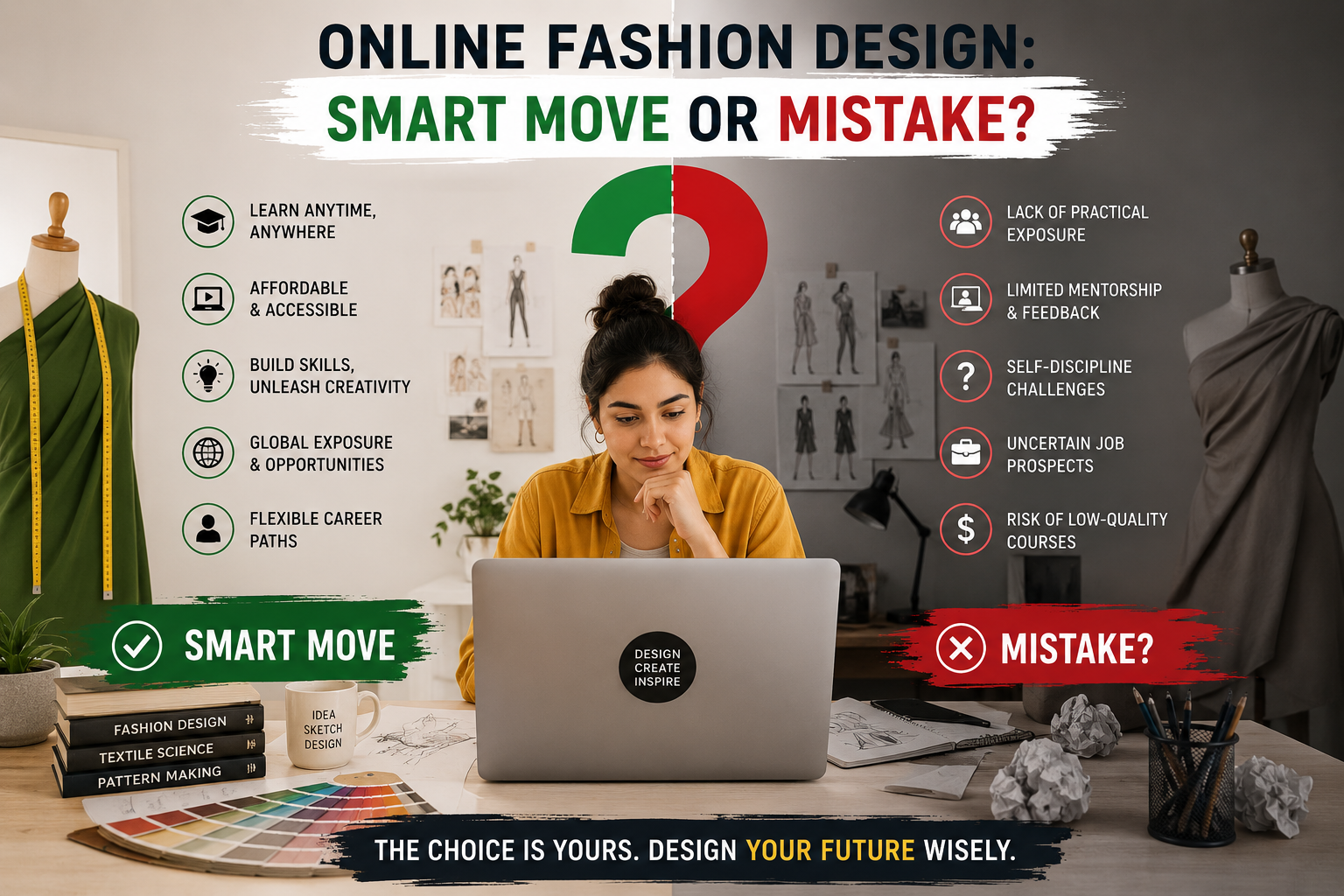
Online Fashion Design: Smart Move or Mistake?

“Fashion is the armor to survive the reality of everyday life.” – Bill Cunningham

The runways are no longer the only places for fashion. It’s around you, right in front of you, in your everyday life and in how people communicate. As there are a lot of online resources today, you may think that you can build a career simply by taking an online course in fashion design.

However, the true question is,


Is that enough?

Can an online fashion design course, or you can say when you learn online, truly match the learning experience offered by top fashion design colleges offline or even the best fashion schools in the world? You already know the Answer!

The simple truth is that. Technology can help you get started. However, to establish a career in fashion, the theory is not enough.


Can You Learn Fashion Design Course Online?

Sure, you can learn the fundamentals on the web: You can learn trends, refine your drawings and think of new ideas. Fashion is more than just concepts. It’s the execution that matters.

Practical experience with skills such as draping, pattern making, garment construction, and fabric handling is essential. These cannot be learned on video!

This is why students opt for fashion design programs in a structured setting within a fashion design university or a professional fashion design Institute setting. These institutions combine the right proportions of creativity and technical skills.

At NIF Global, students learn concepts and much more. They use real designs, try out various materials and create real garments.


Why is online learning not sufficient?
Online learning is flexible without direction. No one will be there to watch and correct your mistakes or to take you step-by-step. Over the years, this has reduced the the growth rate.

Hence, when students are serious about their skills, they tend to look for fashion designing colleges near me or fashion designing institute near me.

While researching a fashion institute near me, students compare the possibilities with the best fashion colleges in the world to make sure they’re making the right call.

NIF Global fills this thing (this gap) by providing a structured learning approach. We have all the practical assignments, and an environment that mirrors the fashion world.


What Sets the Best Fashion Design Schools Apart?

If you examine the best fashion design schools and the best fashion schools around the world, you will see that there is one thing they all have in common: their emphasis on real-life preparedness.

They provide mentorship, live fashion shows, internships, and great portfolio development. This is what makes them different from average fashion and design colleges.

Nowadays, students are more knowledgeable. They make a comparison between various fashion and design colleges and decide upon the appropriate one.

While at NIF Global, students have opportunities to showcase their work through platforms such as Lakmé Fashion Week x FDCI. Such exposure is a way to get them into the ‘real’ fashion ecosystem.


Why Does Industry Exposure Matter So Much?
In fashion, there is no theory. It is result-driven. A degree is not as important as your portfolio.

This is why one of the main things that good colleges for fashion design emphasise is on practice. There is a great need for good colleges for fashion design, as they are aware of the need for hands-on experience.

At NIF Global, students are involved in fashion events, working on projects at an industry level and benefiting from a level of exposure that helps them to develop in confidence and clarity.

They also get mentoring opportunities from top-notch designers such as Manish Malhotra, which is another added value to their careers.


Are you a fit for NIF Global?

If you want to take it seriously to make your career in fashion, then it is important to select the right institute.

NIF Global is one of the best institutes for fashion designing due to an industry oriented approach to students. Indeed, it is emerging as a top fashion design institute for many students desiring creativity and job growth.

NIF Global provides courses like B.Voc, M.Voc, and certification courses. In addition to the academic subjects, it emphasizes portfolio development, exposure to the industry, and practical, hands-on experience.

This blend assists students with the transition from student to professional.


Wrap Up

Do you also think it is a wise decision to pursue online fashion designing, or is it a blunder? Are you still confused?

It’s a good place to begin! However, it’s not enough to build a career. (As practical knowledge wins)

You have to learn a lot of things if you want to be successful in fashion, such as getting experience, which is most important, and of course, the guidance of the proper kind. This is where a good fashion design institute comes into play.

An excellent fashion design college not only educates you. It teaches you what it’s like in the real world.

NIF Global is all about that a place where creativity meets opportunity, and learning becomes a career.

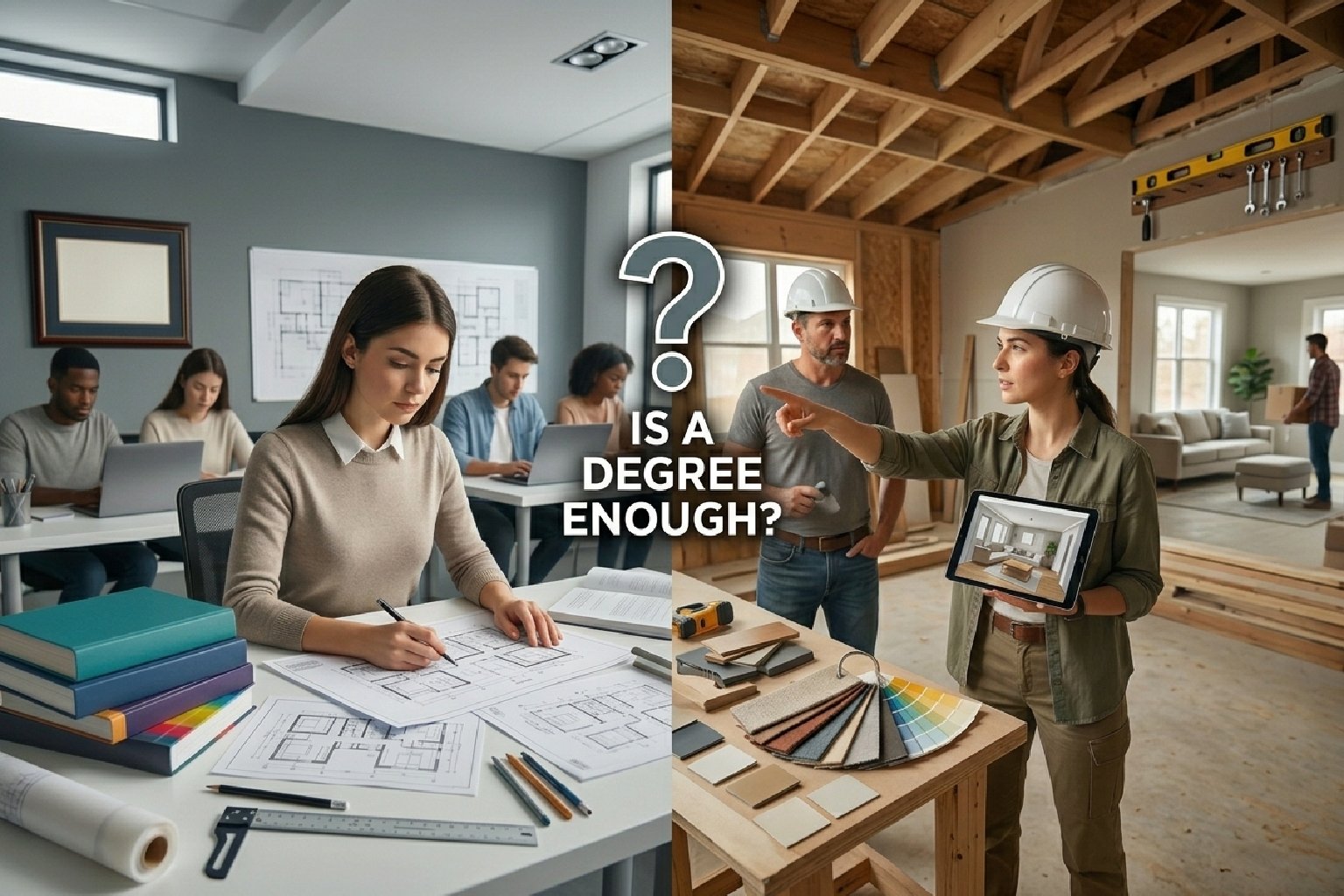
Is a Design Degree Enough to Build a Career in Interior Design?

It’s a lot simpler to observe the outside of interior design than it is to see the inside of it. Choose furniture, colors, and create a beautiful room! But once you are in the profession of interior design, you realise that it’s quite technical and detailed.

Many students think that they need to have an interior design degree to start a career in interior design. But it’s not the case, though.

Interior design is not all about the knowledge of design principles. It involves how they can be used in real life spaces, real life constraints.

A Degree Builds Your Foundation

An interior design course helps you understand how things work in the interior. You are introduced to layout, lighting, materials, and design concepts. Interior design classes involve assisting you in applying your concepts in projects that you work on in the interior.

A wonderful interior design Institute gives you a systematic structure to play around and learn. But now you’re in a controlled environment. Now it’s the real challenges that lie ahead.

Execution Is Where the Real Test Begins

While it may be possible to design the perfect layout on paper, there are real-world limitations, such as budget, space, client requirements, and site conditions.

This is where your interior design portfolio will come in handy. Shows skills in problem-solving. If you can’t execute the designs, then at the best interior design institute, success is nothing.

Site Experience Changes Everything

The biggest difference between students and professionals is experience in the sites.Real project work helps you to prepare for the unexpected. The materials might not perform as intended. Changes to some designs may be necessary. There may be a need to change requirements during the client’s project.

While a degree in Interior Design exposes you to ideas, on-the-job experience teaches you how to deal with complexity.

Problem-Solving Is the Core Skill

Interior design isn’t just a creative way of working. It is problem-solving.

What’s the best way to utilize a small area?

What is your approach to finding a balance between aesthetics and usefulness?

How do you work within limitations?

These are the types of questions you’ll have to answer in a true interior design career. And these skills are acquired through experience and not classes only.

Communication Matters More Than You Think

When it comes to interior design, it isn’t just about you. Develop designs for a client.

Communicate, support, and be in sync with the client’s expectations.

It is a very much required skill in real projects; however, few interior design classes have the opportunity to develop this skill.

So, Is a Degree Enough?

An interior design degree is very important, as it provides you with guidance and knowledge (which you cannot get without learning). However, this isn’t enough.

Below are the skills that are necessary for a successful career in interior design:

  • Practical experience
  • Strong execution skills
  • A full range of interior design projects.
  • Problem-solving ability
  • Communication skills

These are the things that make up your development.

Wrap Up

Interior design isn’t only about learning how to design interior spaces.
It is, in fact, a matter of getting an idea about how those spaces will function in the real world (Not just the images).

An interior design course provides you with a base, but you have to make it grow to live up to it.

You can build a successful interior design career. You get to concentrating on building your experience, skill level, and portfolio.After all, it’s not all about the degree.

It’s all about results, the actual ones.

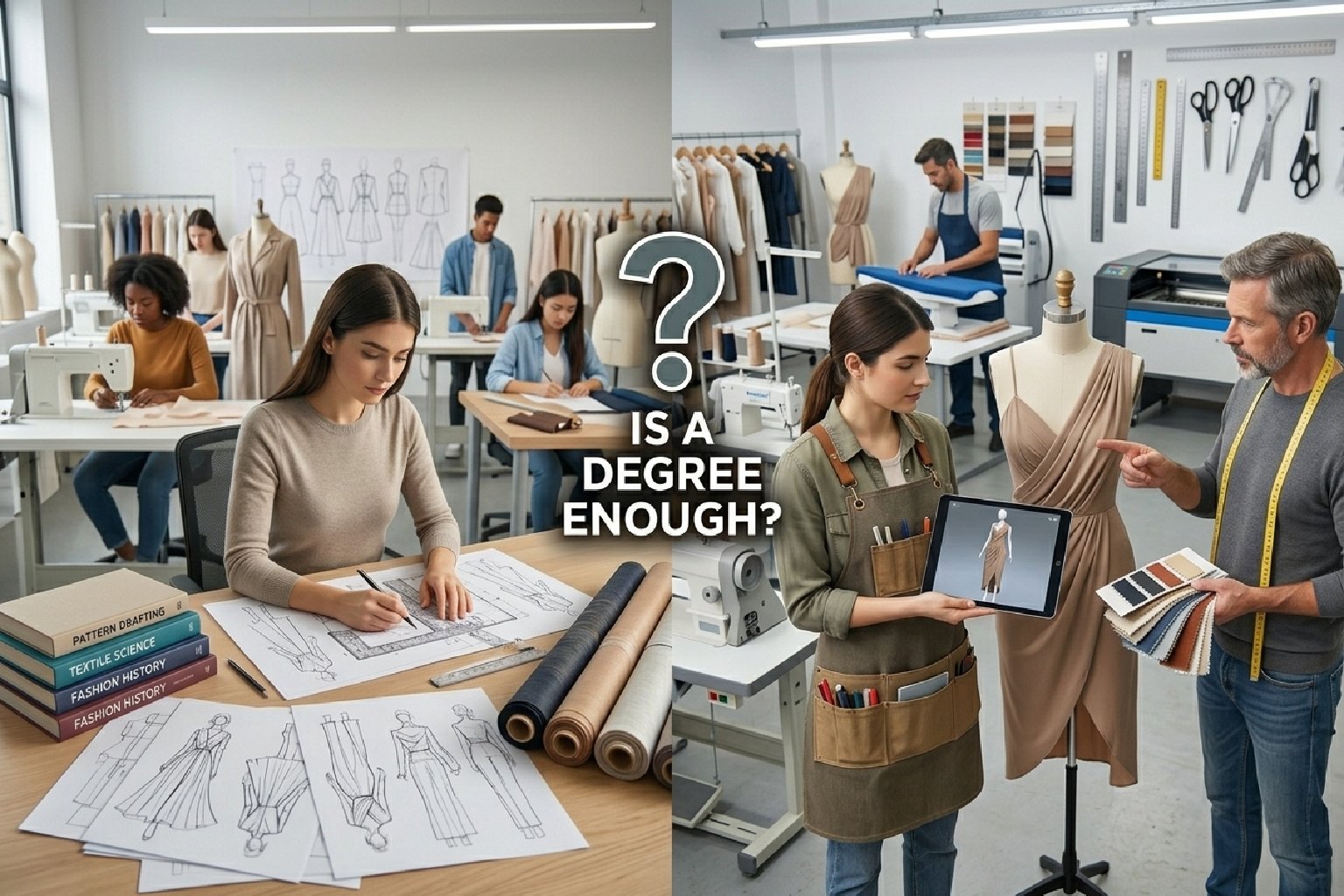
Is a Design Degree Enough to Build a Career in Fashion?

Many students enter into the world of fashion with only one idea in their minds: “I am going to get my fashion design degree, and then all will be well.” It’s so like a natural path. Study, graduate, and then pursue a career in fashion design.However, as soon as you’re in the industry, you realize this important thing. Fashion doesn’t operate on any degree. It’s about output, consistency, and being able to get ideas to life.The fashion design course provides direction. It is an introductory course to the fundamentals. However, the industry has much more to offer than just academics.

A Degree Gives You Direction, Not Identity

Structure is an element of fashion design that you learn when you enrol in a fashion design course. You have an understanding of silhouette, texture, fabric, colour coordination and construction. In fashion designing classes, too, you begin to create fashion assignments to challenge your creativity.

The best fashion designing Institute in India will assist you in exploring various aspects: styling, illustration, garment construction and concept development.
However, at this point, you are still in the exploratory phase: Your design style is still in the early stages of development.It’s not about which institute you went to; it’s about who you are as a designer. It is a process that takes time and is a result of your effort.

The Industry Looks Beyond Your Degree

The truth is, brands, designers, and employers don’t simply concentrate on your educational institution. They take a look at what you’re able to do.

Your Fashion Design Portfolio is your best asset. It demonstrates your thought patterns, ideas, and execution.

No matter if you’re a graduate of the top fashion institute in India, your development will rely on the quality of your portfolio. When your work is outstanding, opportunities come along. Otherwise, the degree will be of little value.

Fashion Is About Consistency, Not One-Time Talent

A lot of students think creativity is related to being good at thinking. A lot of students think that creativity is about having good ideas. However, it’s consistency that it’s really about.

You must continue to make more. Keep experimenting. Keep improving.

You will start your fashion design course, but your success will be determined by the amount of practice that you get outside of class. It’s about sketching each day, developing new ideas, and studying trends – all of these contribute to your development.

The fashion design career is not for the talented few; it is the one that’s consistent that has the rewards.

Exposure Makes the Real Difference

One of the most significant fashion-changing moments is when you leave the Institute.

Collaborations, freelancing, fashion designer jobs, and internships will give you a first-hand glimpse into the industry. You know the time constraints, situations involved with production and what your clients expect.

This is something that a fashion design degree won’t teach you. It can lead the way, but through actual exposure, you will learn how to adapt and deliver.

Trends Change. Skills Stay

Fashion is one of the quickest-changing industries. Sometimes, that work in the present day will not work the next day.

That’s why you can’t just depend on the knowledge that you gained in your fashion design course. It is essential to have constant awareness, learning, and adaptation to time.

You are more useful with your adaptability skills than your degree.

So, Is a Degree Enough?

Obviously, if you want to pursue a career in fashion, it is crucial to have a fashion design degree. It helps you to get a grip and get started.

However, for someone to have a successful career in fashion design, there is more needed:

  • Strong skills
  • A distinctive design approach
  • A strong fashion design portfolio.
  • Real-world exposure
  • Continuous learning

Once all these factors combine, you’ll begin to shape your career.

Wrap Up

Education can open doors, but can’t walk you through them.

It’s up to you how you utilise what you’ve learned; that will shape your fashion journey. A fashion design course provides you with the tools, but your effort, creativity, and consistency are your future.

In fashion, everything is about your work.

And your level of education follows. But don’t forget to learn from the best fashion designing institute, like NIF Global.

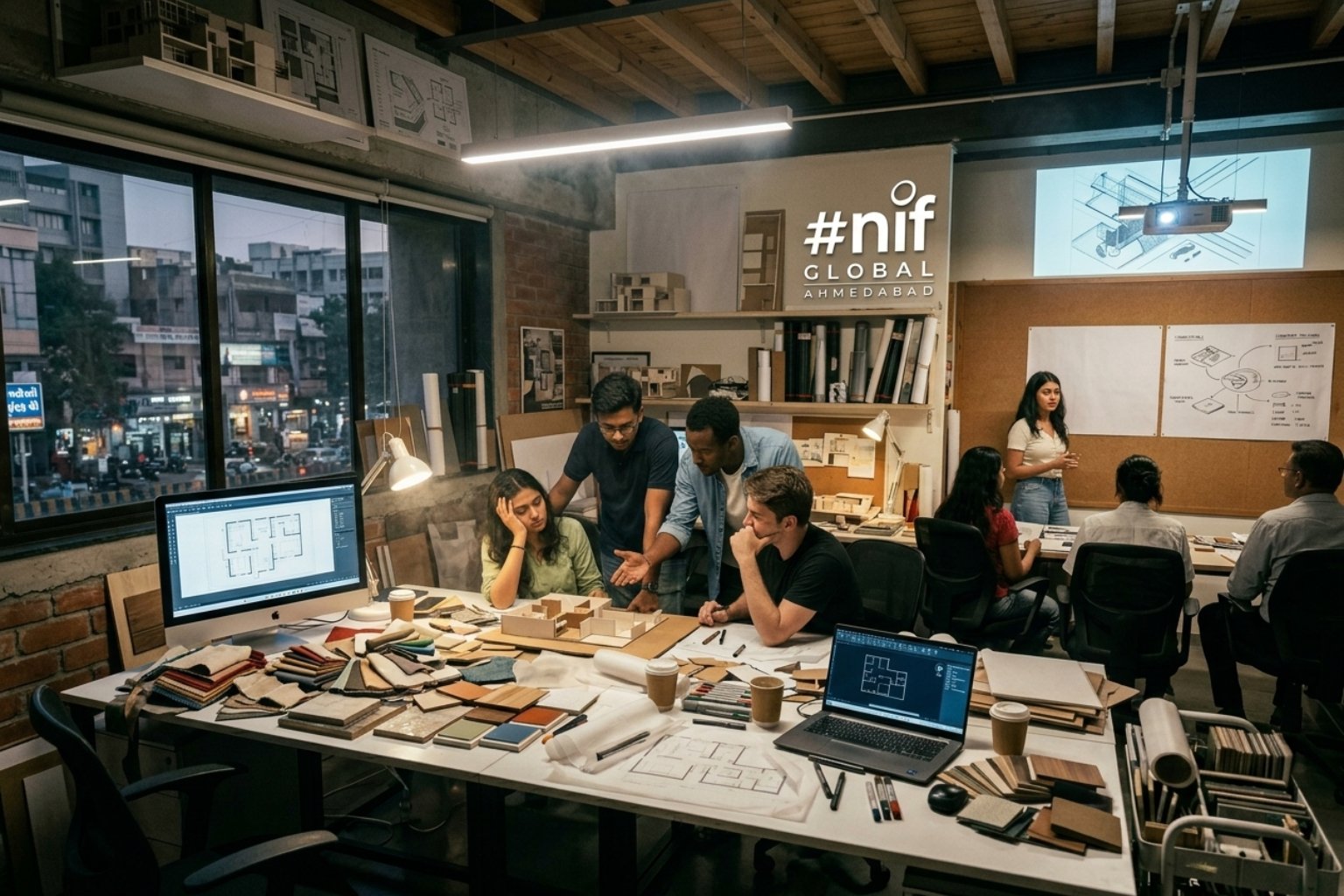
How Is Interior Design Institute Life Really Like?

If you have ever looked at the perfectly styled rooms online, you will recognize the warm lighting, the perfect clean layouts and the perfect feeling. All the things seem creative and thrilling from the outside. However, when you enter an interior design class, you will discover much more going on behind the scenes of those images.

Interior design isn’t merely decorating a space. It’s all about knowing how a space works, how people use it, and how the design decisions can impact people’s lives. This is what you will start to feel within an interior design institute.

It Starts With Observation, Not Just Classes

Lectures are not the only things that make up a typical day. You begin to notice spaces and how they are organized, the different light levels and how they make spaces feel more or less comfortable, as a student at an interior design institute.

When you’re in an interior design class, you start to apply this habit of observation to your thinking everyday. You’re not just in class, you are studying and observing the world around you and taking in what you see.

Planning and Sketching Become Routine

Interior design isn’t merely about concepts, it’s about structuring ideas. So sketching, planning and laying out becomes your daily activity.

In interior designing courses, you create ideas, floor plans and visual ideas, which begin to take practical meaning. You learn over time how to make minor tweaks to the design and it can make all the difference. 

You Learn to Think Practically

The major transition that occurs is when one begins to think in terms of measurements and proportions. Interior design is not merely a creative art, but also a precise art.

In an interior design institute, you will learn how to make the balance between creativity and logic. When creating designs, you think about dimensions, scale and use of space. That’s where the art of interior design classes becomes more than just creative sessions; it’s a blend of design thinking and real-world application.

Materials Change Your Understanding

When you begin to use materials, you have a new outlook entirely. You start to see how things look great, but don’t work.

Professional interior design courses involve studying materials, finishes, and textures. This practical exposure will help you to develop a greater insight into the performance of designs in the real world. It also provides more depth to your interior design portfolio, which is more useful and ready to be used in the industry.

Mentors Help You Think Differently

A good interior design institute does not confine teaching to the mere explanations of concepts. Mentors question, challenge, and push you to make better choices and think.

It may be challenging at first, but it is a very important step in defining your approach. With the passing of time, you realize that interior design is not only about creativity but it is also a process of making every wise and logical choice.

Projects Feel Like Real Work

An interior design class assignment isn’t only an academic assignment. They are designed to reflect real industry work. You work on layouts, concepts and ideas for clients that replicate real work.

All these experiences are good for creating an interior design portfolio that will be crucial in an interior design career. The more you have to do your work, the more you believe in your skills.

Deadlines Prepare You for Reality

Student life at the interior design school is not all sunshine. Deadlines and revisions, and times when things don’t go as anticipated.

But in this pressure, you get ready for the real interior designing career where time management and consistency would play an important role. You are taught to deal with difficulties, enhance your work and achieve results in a specified span of time.

You Start Seeing Spaces Differently

There are a few big differences in perspective when it comes to spaces. You no longer see them around casually but start to study them in detail.

During the course of your interior design journey, you start to see patterns, lighting, furniture arrangement and circulation in a space. The change in point of view is what really makes you grow as a designer.

What Is Interior Design Institute Life Really Like?

So, how is life at an interior design institute? It’s about creativity, learning and continuous improvement.

You face challenges and growth within an interior design institute. Some days are fun, some days are challenging us to rethink our ideas. However, all experiences are part of the journey!

So if you are still wondering what interior design institute life is like, you need not have any doubt about it as it is a process that doesn’t just affect how you think, create and solve problems.

Wrap Up

It is a learning, experimental and improvement process every day in the life of Interior Design students.

An interior design course is not only a way to learn, it’s a way to think. How to observe, analyze and make meaningful spaces.

At the end of your journey in an interior design institute, you aren’t just a designer with skills. You have an impressive portfolio of interior designs and you have a definite direction in mind plus the confidence to go out and make a real difference in the “real world” of design.

A Day in the Life of a Fashion Student: What Is Fashion Institute Life Really Like?

You’ve likely seen it on Instagram: sketchbooks, fabric swatches, mood boards and all the pretty studio pictures. Everything is creative, exciting and, well, a little dreamy.

However, what exactly does it feel like to be in a fashion institute day in and day out?\

The reality is, it’s thrilling, but it’s challenging, too. As soon as you enter a fashion design course, you know that it is not all about creativity. It’s a matter of discipline, consistency and the ability to think differently.

Morning Starts With Ideas, Not Just Classes

A fashion student’s day is not the typical fashion day. It starts with thoughts.

Even before you begin class, ideas about silhouettes, colors, patterns and concepts begin to run in your mind. You don’t sit idly at a place like NIF Global fashion institute, you interact.

Learning is more of a conversation. You question, you go in new directions, you begin to form your own ideas.

Sketching Becomes Part of Your Routine

Drawing isn’t the only subject taught in a fashion school. It has become a habit.

Your sketchbook is there for you from sketching out initial ideas to the most specific of fashion sketches. Some days, everything works out so great and other days it is like nothing is working.

That’s fine and that is natural. In a fashion design class, creativity does not have to be flawless, but it’s important to be there consistently.

Learning Goes Beyond Paper

This is where things get serious.

From sketches, you start to use real material to create. Fabrics, textures, and structures are integrated in your everyday learning.

Practical exposure is a part of a good fashion designing institute in India. You know the properties of fabric, how it will behave and how designs transfer to the fabric.

Then you get to discover, not all ideas are created equal in reality. However, that is the way learning really works.

Mentors Scape Your Thinking

At NIF Global fashion institute, teaching is not limited to instructions.

Mentors help you through asking the right questions. They challenge you with thinking! They question you.

Sometimes it can be challenging. But as time goes on you realize that you are learning and developing as a student and designer.

Assignments Feel Like Real Projects

Forget typical homework.

Assignments in fashion designing classes are built to depict actual work done in the field. Create concepts for collection development, mood boards, styling ideas, and theme designs.

Your fashion design portfolio is a crucial element of your entire career, and it starts with everything you do.

This is the portfolio which will reflect your skills in the industry over time.

Deadlines Push You Beyond Comfort

Let’s face it, fashion student life isn’t always pretty.

There are deadlines. There are revisions. There are moments when you have to start all over again.

But this pressure is not random. It helps you get used to the real world of fashion design, with deadlines and realities.

You Start Seeing Fashion Differently

This is the place of the change.

You start to see clothes as more than outfits. Details start to become evident: cuts, stitches, fabric, proportions, and finishes.

Your observation improves. Your thinking changes.

Gradually, you begin to comprehend fashion beyond the trend.

What You Don’t See Online?

The final results are displayed on social media.

It doesn’t reveal the process that was used. The trials, the confusion, the many times over until getting it right.

There are days when ideas don’t work. When you have to think differently because of feedback.

However, it is here that real growth takes place. Fashion isn’t simply about being creative,  it’s problem solving as well.

You Grow With Every Step

Each project will make your skills grow. Your confidence builds. You’re better able to think clearly.

You begin to get a sense of your style. What works for you. What doesn’t.

And pretty soon you don’t have to wonder about anything you do. You start to rely on your intuition.

It’s More Than Just Learning

Fashion design Institute does not only involve learning how to design, it also involves the understanding of the process of design as well. It alters your thinking, your observation and your creation.

Fashion education doesn’t only happen at NIF Global fashion institute. It is about teaching students on how to solve problems in the real world of industry with proper training in practical and fashion designing.

Wrap Up

Therefore, what is a fashion institute like?

It’s creative. It’s challenging. It’s unpredictable.

There are some days you’re inspired. There are times when you feel “stuck”. Each day however, you learn something new.

Those who want to pursue a career in fashion design might not expect these paths to change them.

After all, fashion isn’t merely a course of study.

You begin your life.You begin living your life. You know the best career is – fashion design career.

Common Obstacles Students Face in Interior Design Admissions

The increased popularity of interior design as a profession has tempted many students to think of doing an interior designing course after 12th and even an interior design course after 10th. As more people are searching for interior design course admission 2026 and are becoming more aware of interior design colleges in India, the industry is becoming competitive and opportunity-driven. The industry, however, may appear to be creative and exciting, but the admission process usually has challenges that the students may not be well-equipped to face.

Some of the important steps that need to be clarified include understanding the admission process of interior designing, assessing the cost of interior designing courses, and preparing to enter the interior designing field. These steps might be confusing and overwhelming to the students without proper guidance.

Understanding the Right Course Path
The choice of course is one of the first things that students have to deal with. When they are considering taking an interior designing course after 12th grade or an online interior designing online course, they come across various choices that include a diploma in interior designing, degree programs, and interior designing certificate programs. The fact that there are online courses in interior design provides even more options.

Students find it hard to comprehend the course of interior design, the duration of the course and which course best suits their career objectives. Also, achieving clarity over the interior designing syllabus is significant as it enables the students to know about the subjects, the practical exposure and skills they are going to acquire in the course.

Managing Fees and Financial Planning
The other significant issue is the expense of undertaking interior design education. According to searches on the cost of interior designing courses, cost is a major determinant in decision making. Interior designing for government colleges is a choice of many students who believe it will be cost-effective and some students seek exposure in private institutes.

Yet, no straightforward, consistent information regarding fees and value is available, which complicates the comparison of alternatives. This usually causes indecisiveness, time wastage, or trade-offs in selecting the appropriate institute.

Navigating the Admission Process
The process of admission to interior design might be more elaborate than expected. Students should be familiar with the interior design eligibility requirements, fill out the applications correctly, and, in certain instances, take an interior design entrance exam.

Without appropriate consciousness, it becomes difficult to control deadlines and to prepare for entrance tests. A good number of students fail to get good opportunities just because they do not have complete knowledge of the procedure.

Portfolio Preparation Challenges
One of the major requirements of admission to the best interior design colleges in India is a good portfolio. It demonstrates the creativity, sense of design and the visual thinking of a student. But, not the majority of students know what the interior design portfolio requirements are.

Students find it hard to determine what to include, how to put their work across and how to make it stand out. This very challenging preparation sometimes may lower their confidence and impact their opportunity in the selection process.

Choosing the Right Institute
To identify an appropriate course, students often find a course in interior designing near me or interior designing courses in Ahmedabad. But it takes more than convenience to choose the best interior design institute.

It is necessary to compare various interior design colleges in India in terms of their faculty, infrastructure, curriculum, and placement. Decision-making on the basis of location or fees alone may not help in long-term career development.

Uncertainty About Career Opportunities
The hesitation of many students is due to the fact that they are not sure of their future in this field. They find career opportunities in interior design to establish job descriptions and growth opportunities.

The uncertainty, in the absence of clear guidance, creates hesitation even with the students who have a strong interest in interior design.

Conclusion
Interior design is a vibrant and good career, yet the admission journey should be planned and clear. From choosing the correct interior design course after 12th to knowing the interior design course fees and preparing to take the entrance test, each step is very important.

The admission process of interior design may appear to be complicated but it can be handled with the proper approach. The journey can become easy by understanding the interior design syllabus, researching the institutes thoroughly and focusing on long-term goals.

To students intending to apply to a course on interior design in 2026, it is important to be up to date and assured in your plan. Preparation, which means planning before choosing the best institute of interior designing will help in overcoming these challenges and building a strong foundation for a successful career in interior design.

Common Obstacles Students Face in Fashion Design Admissions

Fashion designing courses are in high demand after 12th, and the number of students choosing creative and skills-based careers is increasing at a very high rate. As more and more people search for fashion designing course admission 2026, the best fashion designing institute, and fashion design colleges in India, it is apparent that fashion is no longer a mere passion but a career choice.

But the industry sounds promising; the path to admission is not always easy. Students may encounter numerous issues, starting with the fashion design admission process, calculating the cost of fashion design courses and the fashion design entrance exams. Such barriers may cause confusion, postponement of decisions, and even cause a lack of confidence when not handled appropriately.

Lack of Clarity About Courses

Students are confronted with one of the biggest challenges: confusion about course options. When they search for a fashion design course after 12th or a diploma in fashion design, they get several options, such as degree courses, short-term certificates, and even online courses in fashion design.

This broad range of choice can be quite confusing. Students are unable to comprehend the course duration for fashion design, a course that aligns well with their objectives, whether to pursue a diploma or a full degree. In the lack of clarity, most people end up making hasty or wrong decisions.

Confusion Around Fees and Investment

Another significant challenge is the knowledge of the cost of education. Queries such as course fees of fashion designing and of government fashion designing colleges indicate that students are very much worried about the cost. The issue is that the fees differ greatly in relation to the institute, type of course and facilities. Whereas there are those students who aspire to attend the best institutes, others are intimidated by uncertainty over their pricing systems. This misunderstanding usually results in postponements or compromises in selecting the appropriate institute.

Complex Admission Process and Entrance Exams

Fashion designing admission process is systematic, particularly for the reputed institutions, such as NIF Global. Most of the students do not have a proper understanding of the fashion design eligibility requirements or the preparation required to take the entrance exam for fashion design. Organising application deadlines, creative tests, and exam patterns needs to be planned. In the absence of guidance, students will miss a lot or not do their best.

Portfolio Preparation Challenges

One of the most significant and challenging aspects of fashion design admissions is the preparation of the portfolio. Aspiring students to the most prestigious colleges of fashion design in India are supposed to showcase their creativity in the form of a portfolio. Nevertheless, new entrants usually have difficulties with fashion design portfolio requirements. They are not certain of what to encompass, how to make their work presentable, or how to shine. This sense of directionlessness makes this process a stressful one, and it may influence their selection prospects.

Difficulty in Choosing the Right Institute

Although students often go online and look at fashion designing course near me or fashion designing courses in Ahmedabad, to choose the best one, it is important to evaluate them further.

Such aspects as the quality of the faculty, the exposure to the industry, placement, and curriculum structure are significant. Most students are just concerned with where or how much it costs, but this is not necessarily the most successful career path.

Lack of Career Direction

The other widespread problem is the lack of confidence in future opportunities. Students tend to seek career opportunities in fashion design so as to know the extent of this area. Inquiries concerning job descriptions, careers, and compensation generate anxiety. Lacking a sense of career direction, students cannot dedicate themselves, even when they are particularly interested in fashion design.

Information Overload

Students are usually confused rather than informed by so much information on the web. When one goes to search for the best fashion designing institute or fashion designing admission process, he/she gets several sources that have various opinions. Such overload prevents one from being able to find dependable information and make decisive judgments, particularly in the case of first-time applicants.

Conclusion

A career in the field of fashion design is a fascinating experience, and the admission process is associated with a number of difficulties. Whether it is choosing the appropriate fashion designing course after 12th, knowledge of fashion designing course fees, or preparing for fashion designing entrance exams, all this needs awareness and preparation.

Although the fashion design admission procedure may be complicated, it is not hard with the right direction and research. Students who remain updated and assured can eliminate these challenges and make improved choices. In case you are thinking about fashion designing course admission in 2026, work on clarity, preparation, and selection of the most suitable fashion designing institute that suits your objectives. A right start will not only guarantee you a place in the college but also in a successful career in the fashion industry.

Wants to Learn From Celebrity Mentors Directly?