Top Skills Every Interior Designer Must Have

So what really makes a good interior designer?

Many people begin by enrolling in an interior design course or even attempt to learn interior design from the comfort of their home with an online interior design course or an online interior design class. With so many options like interior design certification online, interior design diploma online, or even an interior design course online free, it feels like everything you need is easily available.

However, as you go out, you realize that it is not so because…

Interior design is more than aesthetics. It’s the way that it works. The movement of people, the fitting of elements, and how things come to life in a real situation. There, it’s not only about creativity anymore; skills come into play.

That is what the difference is between dreaming about learning… and really becoming a designer.

Understanding Space

Space is the beginning of all forms of interior design. It’s not only about furniture placement, or decorating the walls! It’s being aware of the use and usability of a space and how it flows.

While working in real spaces is the best way to gain a real understanding, you can also learn the basics via online interior design classes or an interior design beginner course.

Strong Design Sense

Creativity is essential but it must have direction. A good sense of design implies being aware of balance, color combinations, textures, and harmony.

This is created with interior design learning and regular exposure. This is why the top interior design programs emphasize creativity, as well as design thinking.

Knowledge of Materials

Many materials may be different in real life from what you will view in an online study of interior design or even in an online interior design degree. One of the most important tasks is knowing the best places to go, how long it will last, and how much it will cost.

Communication Skills

Interior design is not something you do alone.

You work with clients, vendors, and teams. You need to clearly explain your ideas and understand expectations. This is something no interior design certification can fully teach, but the way they teach plays a huge role in real projects.

Technical Knowledge

Design is more than visual. Some technical knowledge is required as well.

Layouts and measurements, software tools, all part of it! While many interior design courses and interior design professional courses teach skills such as AutoCAD or SketchUp, using these in real-world projects is a different story.

Problem-Solving Ability

Life isn’t always as successful as it could be.

There is a design that may not fit. Materials may not be available. The decision to change may be made by the client. It’s what you do with it that counts.

It is one of the most essential interior design skills, and it is developed using actual experience.

Attention to Detail

It is the little details that make all things happen.

The overall space can be affected by a slight difference in color, a wrong measurement, or a mismatch in lighting. Any good designer will be aware of these details on the ground and correct them before they become issues.

Practical Exposure

It is this that ties everything together.

There are different approaches, such as interior design education programs, interior design programs, and even attempting to learn interior design via different apps. But until you work on real projects, things don’t fully make sense.

Real exposure creates confidence, clarity and real understanding.

Why Does Learning the Right Way Matter?

When it comes to pursuing a career in interior design, skills are more important than anything else.

Skills are not learned while observing but are acquired through practice.

This is why it is important to select the right interior design institute. You may ask yourself, how can you become an interior designer? Proper guidance, systematic learning, and exposure.

The emphasis at NIF Global isn’t in the theory but on the students getting hands-on experience with design through assignments, projects, and exposure.

Interior design is no walk in the park.

It’s something you have to learn.

Conclusion

Interior design is more than creativity; it’s an art learned through skill.

To pursue an Interior design career, learn the right skills rather than gathering bits and bits of information from other sources.

After all, it is not what you know that matters most.

It’s based on what you are able to create.

Can You Really Learn Interior Design Online?

A question that comes in everyone’s mind – Is it possible to learn interior design online?

It sounds easy. You enrol in an online interior design class, watch a few videos and begin to design interiors. There are countless interior design courses online these days, and it seems as though you’ve got all that you require just within your reach.
Actually, that’s how most people start…

Here’s one important thing most will discover later in their career, however: interior design isn’t just a matter of mastering. It’s about physical reality, not just talking about it.

If you are at the beginning of the process, you are thinking of starting with basics. You should consider taking an interior design course for beginners or even the free online interior design course. As we know, many design program options are available, and some are even listed among the best interior design courses for beginners.

So, is an online interior design course enough?

Interior design online classes are a good starting point.

You can acquire fundamental design concepts, learn color theory and layouts, and even get lessons in AutoCAD or SketchUp! Numerous interior design online courses provide you with an understanding of design, as well as space planning.

Initially, it’s just an easy job to do. You learn quickly. You get ideas. You feel confident.

However, after a while, the following becomes difficult for you:

To know design and to apply design, there is a big difference.

Where does online learning fall short?

Interior designing isn’t restricted to the screen!

In real projects:

  • The measurements are not exact.
  • As the materials are not the same when in use, it does not look exactly the same.
  • Lighting changes everything
  • Little details make a big difference

Such are real issues.

This is something that an online interior design course will not be able to prepare you for. One cannot get the advanced interior design skills.

Why does practical learning matter more?

Interior design is a hands-on course.

You don’t just create; you do things.
You need to:

Visit real sites

Understand materials physically

Build or design a real space. 

Construct or design a space.

Real client expectations are to be handled.

This is the place for REAL learning to take place.

This is the very factor that a lot of online students overlook.

What actually prepares you for the industry

Online learning is fine if you’re only interested in learning for learning’s sake.

However, for anyone who wants to make a long-term career in interior design, you don’t just need to know about it online.
You need:

  • Practical exposure
  • Real project experience
  • Industry guidance

It is here that an interior design institute, in particular, comes into play.

At NIF Global, it’s not just about teaching design concepts. It’s all about getting students to really experience a real-life interior with practice, projects and AR training experience.

I must admit, at the end of the day, you’re learning a lot more by doing things yourself than you are by watching others do them.

Why Choose NIF Global for Interior Design?

The best aspect of NIF Global is the emphasis on what really matters in interior design: real learning. The teaching content is no longer concept-based and is more practical and industry-oriented. Students don’t merely learn about design theory; they create projects, work with materials, and see how spaces integrate in reality. Exposure to real and experienced design processes (with guidance from experienced mentors) infuses the learning with a sense of reality and usefulness. 

That’s what’s different: you are not just learning interior design; you’ll be learning how to do it.

Final Thoughts

Then, yes, it’s possible to learn interior design online.

However, when you’re doing it to produce professional results, then it’s not sufficient.

Interior design is about making ‘real spaces.’

That’s the reality: understanding, practice, and experience.

But that’s the real thing that counts.

FAQs

  1. Is learning online Interior Design from home possible?
    Yes, anyone can start. It is a good starting point, but not a perfect end for your career. It is just to understand the basics and explore the field.
  2. Is online learning actually sufficient for an interior design career?
    No, not completely. It is actually not. Hands-on experience and real-world projects are critical for a professional life.
  3. Do you think practical training is important in interior design?
    Yes, it is actually important. You cannot learn about real spaces, materials, and execution challenges online.
  4. What should I choose, online or institute-based learning?
    Basics are to be taught online, but there is a place for real-world skills and industry readiness, which can be learned best from interior design institute.
  5. How does NIF Global help in interior design learning?
    NIF Global provides hands-on learning, industry exposure and real projects for preparing students for the real world of design.

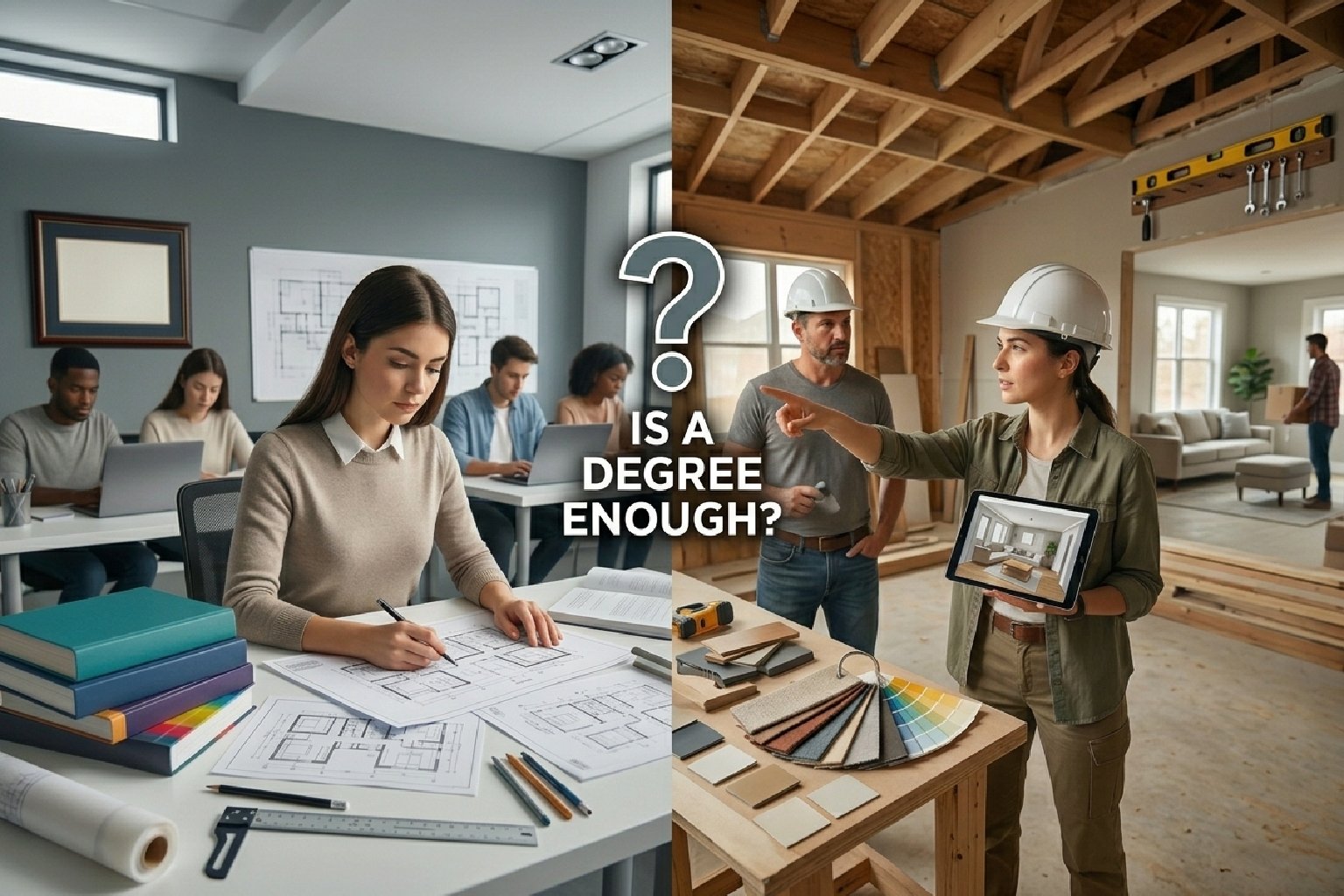
Is a Design Degree Enough to Build a Career in Interior Design?

It’s a lot simpler to observe the outside of interior design than it is to see the inside of it. Choose furniture, colors, and create a beautiful room! But once you are in the profession of interior design, you realise that it’s quite technical and detailed.

Many students think that they need to have an interior design degree to start a career in interior design. But it’s not the case, though.

Interior design is not all about the knowledge of design principles. It involves how they can be used in real life spaces, real life constraints.

A Degree Builds Your Foundation

An interior design course helps you understand how things work in the interior. You are introduced to layout, lighting, materials, and design concepts. Interior design classes involve assisting you in applying your concepts in projects that you work on in the interior.

A wonderful interior design Institute gives you a systematic structure to play around and learn. But now you’re in a controlled environment. Now it’s the real challenges that lie ahead.

Execution Is Where the Real Test Begins

While it may be possible to design the perfect layout on paper, there are real-world limitations, such as budget, space, client requirements, and site conditions.

This is where your interior design portfolio will come in handy. Shows skills in problem-solving. If you can’t execute the designs, then at the best interior design institute, success is nothing.

Site Experience Changes Everything

The biggest difference between students and professionals is experience in the sites.Real project work helps you to prepare for the unexpected. The materials might not perform as intended. Changes to some designs may be necessary. There may be a need to change requirements during the client’s project.

While a degree in Interior Design exposes you to ideas, on-the-job experience teaches you how to deal with complexity.

Problem-Solving Is the Core Skill

Interior design isn’t just a creative way of working. It is problem-solving.

What’s the best way to utilize a small area?

What is your approach to finding a balance between aesthetics and usefulness?

How do you work within limitations?

These are the types of questions you’ll have to answer in a true interior design career. And these skills are acquired through experience and not classes only.

Communication Matters More Than You Think

When it comes to interior design, it isn’t just about you. Develop designs for a client.

Communicate, support, and be in sync with the client’s expectations.

It is a very much required skill in real projects; however, few interior design classes have the opportunity to develop this skill.

So, Is a Degree Enough?

An interior design degree is very important, as it provides you with guidance and knowledge (which you cannot get without learning). However, this isn’t enough.

Below are the skills that are necessary for a successful career in interior design:

  • Practical experience
  • Strong execution skills
  • A full range of interior design projects.
  • Problem-solving ability
  • Communication skills

These are the things that make up your development.

Wrap Up

Interior design isn’t only about learning how to design interior spaces.
It is, in fact, a matter of getting an idea about how those spaces will function in the real world (Not just the images).

An interior design course provides you with a base, but you have to make it grow to live up to it.

You can build a successful interior design career. You get to concentrating on building your experience, skill level, and portfolio.After all, it’s not all about the degree.

It’s all about results, the actual ones.

How Is Interior Design Institute Life Really Like?

If you have ever looked at the perfectly styled rooms online, you will recognize the warm lighting, the perfect clean layouts and the perfect feeling. All the things seem creative and thrilling from the outside. However, when you enter an interior design class, you will discover much more going on behind the scenes of those images.

Interior design isn’t merely decorating a space. It’s all about knowing how a space works, how people use it, and how the design decisions can impact people’s lives. This is what you will start to feel within an interior design institute.

It Starts With Observation, Not Just Classes

Lectures are not the only things that make up a typical day. You begin to notice spaces and how they are organized, the different light levels and how they make spaces feel more or less comfortable, as a student at an interior design institute.

When you’re in an interior design class, you start to apply this habit of observation to your thinking everyday. You’re not just in class, you are studying and observing the world around you and taking in what you see.

Planning and Sketching Become Routine

Interior design isn’t merely about concepts, it’s about structuring ideas. So sketching, planning and laying out becomes your daily activity.

In interior designing courses, you create ideas, floor plans and visual ideas, which begin to take practical meaning. You learn over time how to make minor tweaks to the design and it can make all the difference. 

You Learn to Think Practically

The major transition that occurs is when one begins to think in terms of measurements and proportions. Interior design is not merely a creative art, but also a precise art.

In an interior design institute, you will learn how to make the balance between creativity and logic. When creating designs, you think about dimensions, scale and use of space. That’s where the art of interior design classes becomes more than just creative sessions; it’s a blend of design thinking and real-world application.

Materials Change Your Understanding

When you begin to use materials, you have a new outlook entirely. You start to see how things look great, but don’t work.

Professional interior design courses involve studying materials, finishes, and textures. This practical exposure will help you to develop a greater insight into the performance of designs in the real world. It also provides more depth to your interior design portfolio, which is more useful and ready to be used in the industry.

Mentors Help You Think Differently

A good interior design institute does not confine teaching to the mere explanations of concepts. Mentors question, challenge, and push you to make better choices and think.

It may be challenging at first, but it is a very important step in defining your approach. With the passing of time, you realize that interior design is not only about creativity but it is also a process of making every wise and logical choice.

Projects Feel Like Real Work

An interior design class assignment isn’t only an academic assignment. They are designed to reflect real industry work. You work on layouts, concepts and ideas for clients that replicate real work.

All these experiences are good for creating an interior design portfolio that will be crucial in an interior design career. The more you have to do your work, the more you believe in your skills.

Deadlines Prepare You for Reality

Student life at the interior design school is not all sunshine. Deadlines and revisions, and times when things don’t go as anticipated.

But in this pressure, you get ready for the real interior designing career where time management and consistency would play an important role. You are taught to deal with difficulties, enhance your work and achieve results in a specified span of time.

You Start Seeing Spaces Differently

There are a few big differences in perspective when it comes to spaces. You no longer see them around casually but start to study them in detail.

During the course of your interior design journey, you start to see patterns, lighting, furniture arrangement and circulation in a space. The change in point of view is what really makes you grow as a designer.

What Is Interior Design Institute Life Really Like?

So, how is life at an interior design institute? It’s about creativity, learning and continuous improvement.

You face challenges and growth within an interior design institute. Some days are fun, some days are challenging us to rethink our ideas. However, all experiences are part of the journey!

So if you are still wondering what interior design institute life is like, you need not have any doubt about it as it is a process that doesn’t just affect how you think, create and solve problems.

Wrap Up

It is a learning, experimental and improvement process every day in the life of Interior Design students.

An interior design course is not only a way to learn, it’s a way to think. How to observe, analyze and make meaningful spaces.

At the end of your journey in an interior design institute, you aren’t just a designer with skills. You have an impressive portfolio of interior designs and you have a definite direction in mind plus the confidence to go out and make a real difference in the “real world” of design.

Interior Designing Career 2026: What No One Tells You

Are you also wondering Is interior designing a good career? Interior designing is considered a glamorous and creative career but there is more to it than just a choice of colours and furnishings. This sector is rapidly evolving as we move into 2026 and there is a lot to get excited about- but it is also important to have an idea of what it is really like.

If you’re considering a career in interior designing or if you are considering pursuing an Interior designing course after 12th, you need to see the whole iceberg, not the tip.

It’s Not Just Creativity, It’s Technical Too

One of the misconceptions about interior designing is that it is all about creativity. While it is important to be creative, in reality this is a profession requiring technical skills.

The interior designers should have the knowledge in space planning, materials, lighting, furniture and even the basic principles of construction. It is difficult to execute designs without these.

Institutes like NIF Global Ahmedabad focus on nurturing their creative as well as technical skills which will ensure that they will be ready for the industry. We are open about all the details of the Interior design course.

The Industry Is Competitive, but Full of Opportunities

Interior designing is a growing industry, but also very competitive. Many students enter this field with a passion, but only a few who continue to upgrade their skills, and keep up with the latest trends, manage to stand out.

The good news is that there is a growing demand. The requirement for good interior designers is increasing, whether it is for residential or commercial, office or mall.

All they need is the right education and exposure that the students will get in institutes like NIF Global and they will have a good chance of being successful in the market.

Your Portfolio Matters More Than Your Degree

What most people don’t understand is, your portfolio is more important than your degree.

Employers and clients want to see your designs, your concepts and how you have the ability to execute them. Even if you are a beginner in your career, a good portfolio can help you.

That’s why it is important to learn by doing. The professional course helps you create a portfolio of your skills and practical projects.

Initial Struggles Are Real

Interior designing is not a career that will see success immediately. You may have to start your career with limited projects or internships or even as an assistant.

This is an important period as one also gets to learn and gain some experience. As you acquire more knowledge and experience, you will have more opportunities.

Multiple Career Paths Exist

The job of an interior designer is not one and only. You can be a residential or commercial designer, furniture designer, or even a consultant.

Some might also choose to freelance and even start their own design studios. It’s a versatile field and gives you the opportunity to make your career path according to your interests.

Earnings Grow with Experience

A common question asked by the students is about salary. While the salaries may be average to begin with, the earnings increase exponentially with time and expertise.

The good interior designers with a nice portfolio, network and experience can earn a substantial amount. Freelancing and commissions are also a part of earnings.

Why 2026 Is the Right Time to Start?

There is an increasing demand for having a good design due to urbanization, real estate, and changing lifestyles. People are investing in interiors more than ever.

It’s a great time to start a career in 2026. Students can build the right foundation and take advantage of this growth with the proper guidance and education from institutes like NIF Global.

Conclusion

Interior designing is a good career in 2026, but it requires hard work, training and hands-on experience. Not only the imaginative skills, but the combination of design and execution skills, understanding client needs and the latest trend.

Interior designing can also be a very satisfying career as well if you are interested in changing the appearance of spaces and willing to work for it. All you may need is the right institute to start with and a good attitude.

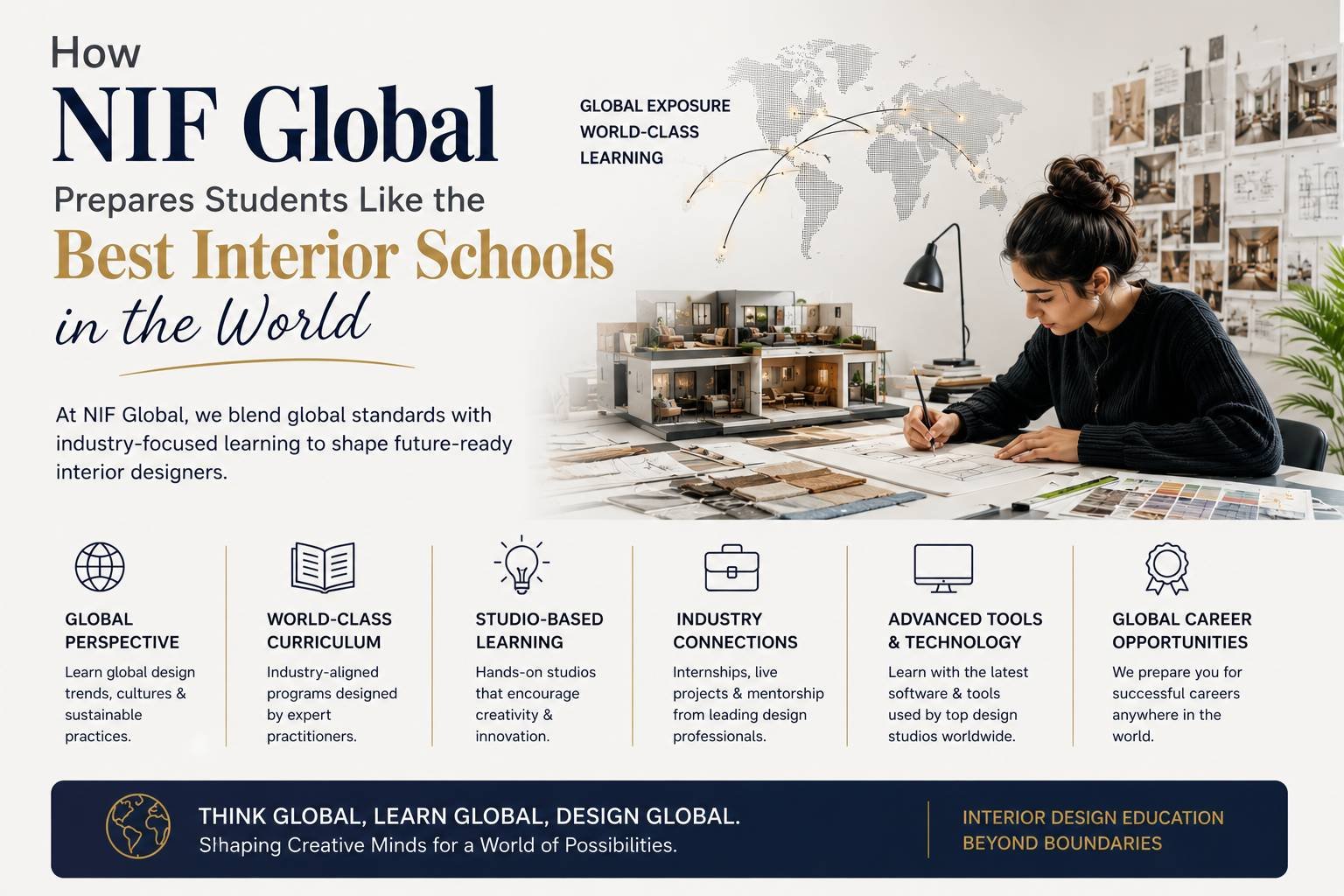
How NIF Global Prepares Students Like the Best Interior Schools in the World

Interior design is a dynamic field nowadays that incorporates creativity, technology and strategy. The most successful interior design schools globally pay emphasis on practical exposure, international approaches of learning and industry networks such that students are well equipped to take up professional careers. 

NIF Global also adheres to the same academic strategy and thus students pursuing its interior design course are provided with the training that is in line with the standards observed by major interior design schools or interior design classes all over the world.

Curriculum Designed on Global Learning Standards

The best interior design training institutes in the world are oriented towards the creativity of thoughts and technical mastery. They do not just teach the students on the art of decoration, but expose them to space planning, understanding of materials, concepts about lights, and human-centered design. 

The syllabus of the professional interior design course at NIF Global is designed in a way that enables the students to learn how interior environments work. Residential, commercial and hospitality interiors are taught to students in order to ensure that they make spaces that are not only attractive but also useful too. 

The structured learning format will assist the students in developing a solid foundation in design such as those applied in learning methods in the well known interior schools across the world.

Focus on Design Thinking and Concept Development

Design thinking is one of the essential elements that determine the best interior design institute. Top educational facilities would promote students to come up with original ideas rather than merely follow the trend. 

NIF Global promotes creativity in students by developing concepts, sketching, and ideating designs. Students are taught to convert ideas into a form of structured interior layout and design presentation. 

This will assist them in realizing that designers transition between inspiration and execution when it comes to working on professional projects. 

Training in Industry-Relevant Tools

Interior design has been made more technologically orientated. International training institutes in interior design make sure that the students have knowledge of the digital design tools used to visualize and communicate the design concept. 

NIF Global combines technical education in interior design courses, which enable its students to know how professional designers can design layouts, visual presentation and interior concepts through the use of digital platforms. 

The insight is useful to students in preparing them to work in the actual industry situations where both creative and technical talents are equally significant.

Hands-On Project-Based Learning

International design schools also feel firmly that interior design should be acquired by practice. Design education today is therefore largely studio based. 

On the same note, NIF Global offers the students project based assignments wherein the students are asked to design different kinds of spaces including home, offices and commercial interiors.

Through these projects, students learn:

  • Space planning and layout development
  • Furniture arrangement and circulation planning
  • Color schemes and material combinations
  • Lighting placement and design impact
  • Functional and aesthetic balance

To work on such assignments will allow students to develop confidence and slowly build up their own style of design.

Exposure to Contemporary Interior Trends

The trends of interior design evolve over time because of changes in lifestyles, technology and sustainability demands. The interior design colleges in India and all over the world are the best and they keep the students abreast with the current trends in designs. 

At NIF Global, students get to learn about the modern interior style, world design trends, and the use of contemporary space in the modern way. Exposure to new trends enables the students to develop interiors that can be updated to suit the current living styles. 

This exposure also assists the students to be versatile and this is a notable attribute of any great interior designer.

Portfolio Development for Career Opportunities

One of the most significant tools as an interior designer is a professional portfolio. Students are taught to create portfolios that present their creative and technical skills by leading interior design institutes. 

The students of NIF Global have a variety of design projects in the course, which help in constructing a powerful portfolio. These portfolios consist of design sketches, mood board, layout plans and project presentation. 

A strong portfolio can make the students more noticeable in seeking internships, jobs in the design firms or freelance projects.

Industry Interaction and Learning Exposure

The other characteristic of the best interior design schools across the globe is the exposure to the industry players. It assists students in knowing the real design problems and professional requirements in the field. NIF Global promotes this exposure by organizing workshops, seminars, and contacts with students that expose them to professional practices in designing. 

The experiences allow students to learn about project management, communication with clients and implementation of designs. This kind of exposure is significant in equipping students to work in the professional environment.

Career Paths After Interior Design Education

Interior design has a wide range of career opportunities that are found in residential, commercial, retail and hospitality industries. Students who have passed a course in interior design after 12th can consider working in roles such as: 

  • Interior Designer 
  • Interior Consultant 
  • Space Planner 
  • Interior Stylist 
  • Furniture Designer 
  • Interior Project Manager 

Others (many designers) have independent careers as they start their own design studios or consultancy services.

NIF Ahmedabad Global vs Other Interior Design Institutes

Choosing the appropriate school of interior design is among the most critical decisions that a budding designer has to make. Having a plethora of options, students tend to find the interior design schools near me or compare various interior design colleges near me and choose the final one. 

When considering the interior design education in Ahmedabad, the question that frequently occurs is this – NIF Global Ahmedabad vs other interior design schools: which one is better? We will divide it up into a simple and practical way, which will allow you to make an informed choice.

The Growing Demand for Interior Design Education

The concept of interior design does not have to be confined to home decor. It now incorporates residential design, commercial space design, retail design, hospitality interior design, workspace design, and sustainable design solutions. The need for the best interior design schools to provide professional education is also on the rise as the industry is expanding. Students do not simply seek a certificate. They desire competency-based education, exposure to industry, building of the portfolio, and career counselling. 

Here is the actual real difference between institutes.

  1. Curriculum & Industry Relevance

Numerous interior design schools adhere to a classical school approach which pays much attention to theory. Though theory is relevant, the industry now requires hands-on exposure, live projects, software training and actual practice. NIF Global Ahmedabad is industry-oriented in learning. 

  • Space planning and concept development.
  • Knowledge and application of materials. 
  • Training in AutoCAD and design software.
  • Portfolio creation 
  • Field projects and reports. 

As compared to your search for other interior design colleges near me, which may rely mostly on lectures in the classrooms, NIF Global focuses on practical learning and project-oriented learning.

  1. Faculty & Industry Mentorship

Faculty is a significant contributor to the career of a designer. Most interior design schools do provide standard teaching models, but when members of the faculty provide industry experience in the classroom, the students are the greatest beneficiaries. 

At NIF Global Ahmedabad, teaching is not merely concentrated on academics, but professional mentorship is also the focus. 

The students become exposed to actual design challenges, latest trends and reality in problem solving. Mentorship and real-life exposure are some of the determinants when making a comparison of the best colleges to study interior design.

  1. Infrastructure & Learning Environment

Interior design is a professional field of a visual and practical nature. Students should have access to good studio facilities, drafting laboratories, material collections and computer resources to be creative. 

Although a few interior design colleges provide classes in small classrooms, NIF Global Ahmedabad provides a formal spacious learning environment that promotes creativity, teamwork, and innovation. 

The appropriate learning environment has a direct influence on the level of confidence that students have in their design thinking skills.

  1. Portfolio Development & Career Preparation

The best treasure of any interior design student is a good portfolio. Designers are evaluated by the recruiters and clients, depending on how they present, how creative and how good they are at executing their ideas. 

Portfolio building is not equally emphasized in all schools of interior design. There are other institutes that have the syllabus though they offer minimal career preparation support. 

NIF Global Ahmedabad gives a lot of focus to portfolio development, presentation skills and preparation to industry. Students leave school with professionally designed portfolios that help them in the job hunt and freelance. 

This is a very important practical career advantage when comparing the interior design colleges near me.

  1. Exposure & Industry Connection

Education in interior design must bridge the gap between university students and the actual world of the industry through exhibitions, workshops, visiting lecturers and shows. 

Most interior design colleges are academically oriented. Nonetheless, NIF Global intends to offer exposure beyond textbooks. The exposure to industry players, factory sessions, and trend setter programs which are used to keep the students updated with the design universe that is changing. 

Exposure is a major factor that stands out in the eyes of a student who wants the best interior design schools.

  1. Course Options & Flexibility

Students are now seeking flexibility in the form of diploma programs, degree programs, specialization modules and short-term certification courses. 

Comparing the college of interior design, it should be noted whether or not the institute has well-laid-out progression options. NIF Global Ahmedabad has a variety of programs to follow, depending on the career aspirations of the student, whether he or she plans to go into work, open his/her own studio, or further his/her education

  1. Student Support & Learning Experience

Creative education is largely contributed to by a supportive academic environment. Some interior design colleges that are large may make the students feel like a number. In NIF Global Ahmedabad, the emphasis is on individual guidance, building creativity and building confidence. Interior design needs conceptual clarity and presentation skills which are enhanced with appropriate mentoring and interactive sessions.

When students are searching for the interior design schools near me they are most likely to find an option of the school, but they should check on quality education and personal development.

Final Comparison: Making the Right Choice

NIF Global Ahmedabad and other interior design institutions all have the goal of offering education.

Nevertheless, the distinction can be seen in the practical exposure, industry alignment, the quality of mentorship, and portfolio preparedness. 

In case you are comparing the interior design colleges based on: 

  • Industry-focused curriculum 
  • Hands-on project work 
  • Portfolio development assistance.
  • Imaginative workplace atmosphere.
  • Professional mentorship 

Then NIF Global Ahmedabad places itself at the top of the list of the best colleges in interior design in the area. 

Selecting a school of interior design is not a one-shot decision of taking a course. It is choosing an environment that will make you an innovative person, one that develops your technical proficiencies, and is ready to leave you prepared for an aggressive design sector. You should compare before you make your choice – depth of curriculum, faculty knowledge, facilities, exposure, and career guidance. In the field of interior design, your learning is the basis of your creative future.

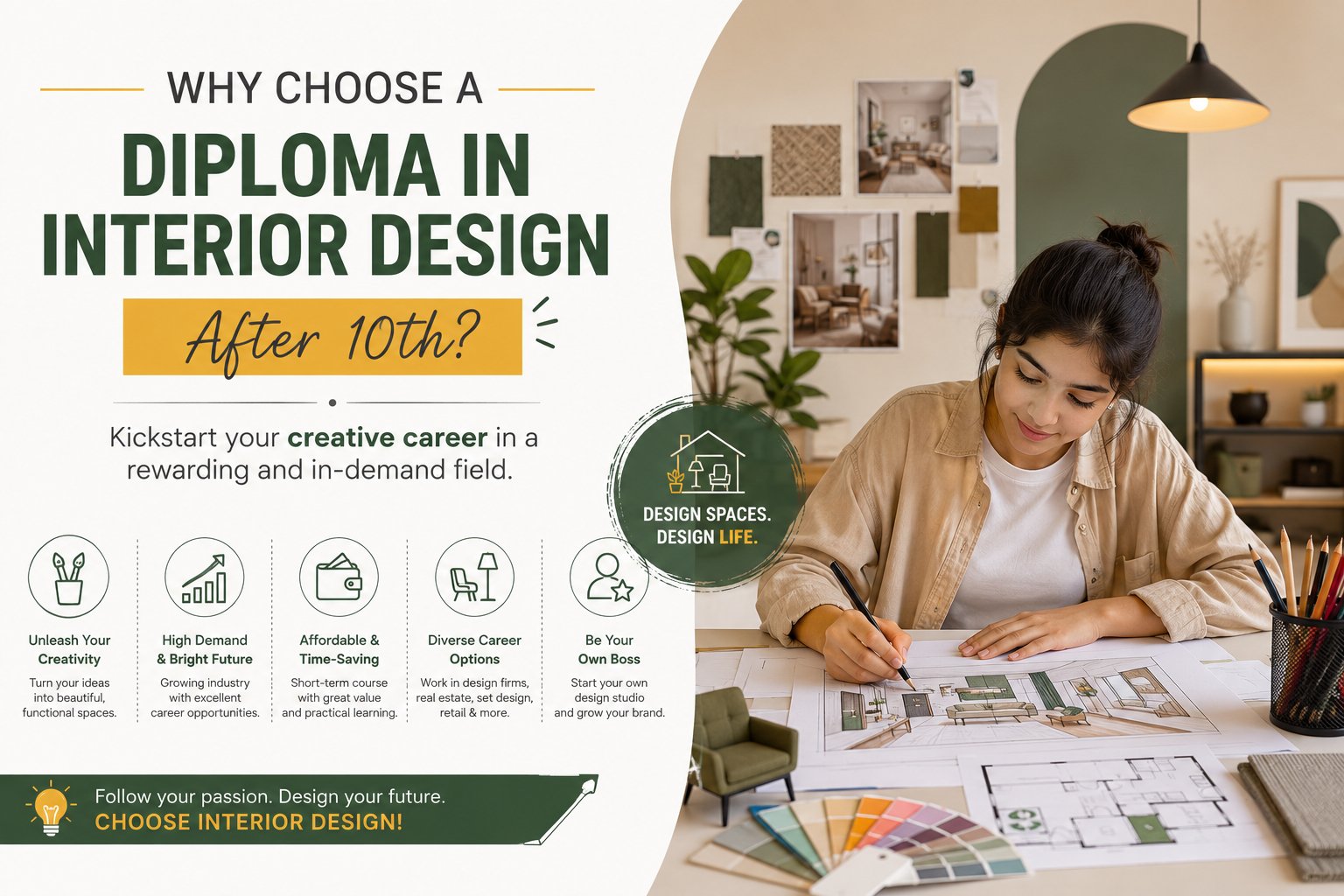
Why Choose a Diploma in Interior Design After 10th?

It is the same question every single time that bothers many students and their parents after high school (10th grade).

“What next?”

Some students are straight on science or commerce.

Others are more artistic, but they are unaware of how to make it a career.

It is at this point that a diploma in interior design would emerge as a possible and worthy substitute.

An interior design course after 10th lets them start acquiring practical skills. It gives a feeling of direction, gives confidence, and results in diversified career opportunities.

Reasons to choose a Diploma in Interior Design after 10th


  1. It allows an early start in a creative career

After 10th, time matters. The diploma will help the students to commence their careers at an early age, instead of waiting for years before they can start. At the beginning, they begin to familiarize themselves with spaces, design thinking, and applications. This also puts them into early exposure to know whether interior design is of high interest to them without wasting valuable time.

2. No prior design or technical background is required

The biggest advantage related to the start of a diploma is that it starts with the basics. No experience of any kind of drawing, technical, or software before joining is actually required. The interior design course is structured in a manner that the knowledge is gained over time. This makes it suitable for students who are studying science, commerce, or arts.

3. Learning is practical and easy to understand

A diploma lays more stress on practical and less on theory. Students learn how to sketch room layouts, simple drawings, and design concepts. They learn using examples of real life, i.e. furnishing a bedroom or a small living room. This is a pragmatic approach whereby learning proves to be interesting and simple to learn.

4. It develops both creative and technical skills

The design of the interior is not just a matter of making a space look good. It also involves familiarity with measurements, lighting, and the placement of furniture and materials. Students are able to prove their creativity and technical clarity through a diploma. They are made to reason in pictures, and they make spaces that are useful in life.

5. Short and focused interior design course duration

An interior design diploma is achieved in a duration of 1 year to 3 years. This is the condensed time that causes students to be motivated and active. They can complete their education without the massive educational burden and move sooner to work or to further education.

6. Builds confidence at an early age

Design projects can build confidence in the students. They get to know how to articulate their thoughts and represent their work. As time goes by, they feel free to consult teachers, peers, and clients when it comes to discussing designs. This trust contributes largely to their professional development.

7. Flexible option for higher education later

The obtaining of a diploma does not complete the learning process. The students would later have a choice of enrolling on a degree course in interior design if they want more comprehensive academic preparation. Others could go as far as to visit the greatest masters of interior design who are experienced and interested. A diploma is also a good beginning because it gives flexibility and a strong foundation to the students.

8. Opens early career and earning opportunities

Interior design is an art. This can be followed later on when the students get experience working with designers, studios, or small residential work. This would allow them to study in the field and generate income in the process. The students are progressively developed when exposed to the industry at an early age.

Why does choosing the right location matter?

Location is important in design studies. An interior design course in Ahmedabad can give one exposure to residential and commercial space development. Students are allowed to see how design concepts can be used in real projects. The accessibility to studios, showrooms, and active sites is also made possible by such proximity to cities such as Ahmedabad, which is also of practical intent in learning.

Is a diploma a safe option for parents?

Yes. Interior design is a fairly in-demand profession. There will never be a shortage of great designers in houses, workplaces, cafes, and shopping places. It is a career based on skill, and therefore it is more about good ability and experience rather than degrees. That is why a diploma is a good and reasonable choice. Students who want to have the utmost skills practiced, should definitely consider Interior Design degree courses.

Final thoughts

An interior design diploma after-10th is a good step in the right direction, as students like to be creative and obtain a diploma according to their own ways. It helps them to start out early in life, acquire realistic skills, and have a conception of their future. The diploma makes a strong kickstart, whether the students choose to work, pursue a degree course in interior design or even enrol in the best interior design master’s programs in the future.


The interior design is not only decoration.

It is about the notion of space, individuals, and functionality.

A diploma is capable of demonstrating to the students how to do exactly that.


Wants to Learn From Celebrity Mentors Directly?